Steriles Business Case : Recovery from a bad inspection
When an FDA inspection ends in multiple observations, it's bad news. So it was for the European Manufacturing subsidiary of a major multinational.
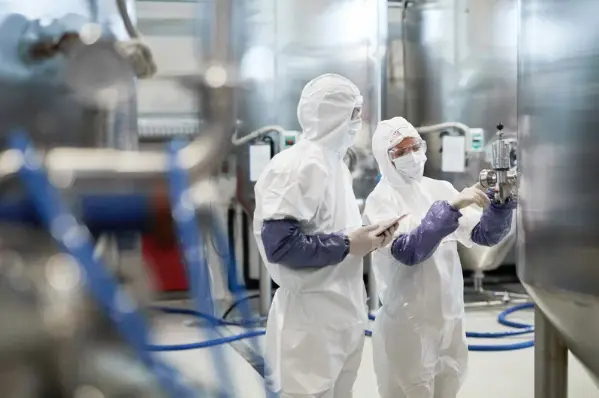
The site manufactured several key sterile products, mainly vials with the major product being a beta-lactamine*, and the FDA required a team of observers to report on sterile suite behaviour and practise; in order to implement the range of the corrective improvements needed. Observations included poor operator behaviour, incorrect gowning, compromise of the class A filling area, poor maintenance interventions and poor monitoring systems.
Knowing Galenisys expertise in sterility assurance and aseptic processing, the multinational Head Office turned to Galenisys to undertake the on-site work, with an experienced team of sufficient strength; in cooperation with local management and coordinated by the Boston Consulting Group and the Galenisys on-site project manager.
After conclusion of the Confidentiality Agreement and agreed Terms of Reference, Galenisys deployed our team of specialists to site. It was headed up by one of our most experienced experts.
Working in teams to observe the 24/7 operation, over a period of months, Galenisys drove the improvements in operator behaviour, and modifications to the procedures and testing practises which were required. Galenisys spent considerable time coaching key individuals in aseptic technique and relevant regulatory requirements. Separate training for the operations and maintenance teams was undertaken. After each observation session, the Production, Maintenance and Quality teams met in an adjacent meeting room where the days observations were presented, and everyone took time to discuss and agree how improvements could be introduced.
Each week, findings and Corrective Actions were discussed with local and central management.
Galenisys included the Corrective and Preventive Actions (“CAPAs”), in the training they gave on appropriate behaviour & revised procedures including aseptic activity monitoring, process validation – sterilisation APS, disinfection and cleaning techniques (a major headache) - data evaluation and use, sterility assurance programmes and contamination prevention and control.
The final phase of the terms of reference was to verify that the required training and updated procedures were resulting in the improvements required, and product conformity.
It’s pleasing to note that the same company has now used Galenisys teams on more than 10 of their sites worldwide to improve aseptic techniques.
Case Study : Root Cause Investigation & Remediation of Sterile Product Contamination
A leading manufacturer of sterile injectable products recently encountered an unexpected microbiological issue affecting one of its well-known pharmaceutical gels based on hyaluronidase. Upon detection of this deviation by their internal Quality Assurance team, the manufacturer promptly engaged Galenisys to investigate the root cause and propose corrective and preventive actions.
Following the signature of a mutual non-disclosure agreement, Galenisys submitted a proposal for an on-site assessment by two senior industrial microbiologists, each with extensive expertise in the manufacture and quality control of sterile medicinal products. The scope of this intervention covered all contamination prevention systems and procedures, including those related to raw materials, equipment, personnel, and environmental controls.
Once our proposal was rapidly approved, the Galenisys experts worked in close collaboration with the site team to conduct a comprehensive assessment. The contaminant had already been correctly identified by the client's QA function as a species of Pseudomonadaceae, which allowed our investigation to focus on potential sources and vectors throughout the facility, including utilities, equipment design, manufacturing steps, cleaning practices, and validation protocols.
Thanks to the transparency and professionalism of the site team, Galenisys was able to pinpoint key contributing factors, notably issues related to equipment design and inadequate cleaning and sanitization procedures. Our experts provided detailed written recommendations, including practical explanations to help operational and QA staff understand the specific conditions under which Ps.spp. can thrive.
Additional recommendations were made concerning the maintenance and management of the purified water system, with a focus on minimizing the risk of microbial proliferation.
Following our intervention, we were pleased to receive confirmation from the manufacturer that the proposed corrective measures had been implemented, and that the issue of contamination had been fully resolved.
This case study highlights the effectiveness of two key formal documents within the Galenisys Quality Assurance framework, which are available to all clients:
- Galenisys Contamination Prevention & Control – Key Elements
- Galenisys Contamination Prevention & Control – Programme
Case Study : Verifying GMP Compliance in a Complex Asian API
Supply Chain
This is how we help companies
In the mid-2000s, European regulatory expectations evolved significantly, raising the bar for Active Pharmaceutical Ingredient (“API”) traceability and GMP compliance.
New EMA requirements made it clear that Marketing Authorisation Holders (“MAHs”) had to demonstrate that active substances were manufactured in full compliance with GMP, including on-site audits of the actual manufacturing facilities and not only of European suppliers or distributors.
This was not surprising since for over 20 years Galenisys have often found serious non compliances when auditing API manufacturers outside the EU.
In this case, a European pharmaceutical company sourcing Histamine Dihydrochloride from Asia was facing increasing regulatory pressure to confirm its supply chain compliance.
Given Galenisys’ long-standing presence in Asia, and our hands-on experience in GMP auditing, regulatory due diligence, and supplier qualification, we were asked to investigate the situation directly on the ground.
The Challenge
At first sight, the documentation provided appeared reassuring:
- A named Chinese “supplier” based in Hangzhou
- A completed raw material questionnaires
- A GMP certificate issued by Chinese authorities
However, as the review progressed, a number of serious inconsistencies emerged:
- Manufacturing was later claimed to take place in Suzhou, not Hangzhou
- QA roles and responsibilities were unclear and did not align with GMP expectations
- GMP documentation showed signs of alteration and possible falsification
- In particular, neither party was willing to host an on-site audit or plant visit.
The risk for the MAH was evident: continuing to source the API without certainty on GMP-compliant manufacturing would expose the company to major regulatory findings, potential supply disruption, and reputational damage.
Galenisys Intervention
Working directly in China, Galenisys conducted a thorough and pragmatic due-diligence investigation, combining regulatory expertise with deep local operational knowledge.
Our work included:
- Detailed cross-checking of raw material questionnaires, certificates, and declared manufacturing sites
- Verification of QA roles and responsibilities against applicable GMP standards
- Critical assessment of GMP certificates for authenticity, scope, and format
- Direct discussions with the various stakeholders involved across the supply chain
Through persistent follow-up and expert scrutiny, Galenisys established that:
- The apparent “supplier” was in reality a trading company, not a manufacturer
- The GMP certificate had been manipulated to include Histamine Dihydrochloride
- The certificate was a copy, not an original (incorrect background, missing SFDA security markers)
- At that time, no credibly GMP-certified manufacturer of pharmaceutical-grade Histamine could be confirmed in China.
Outcome & Value Delivered
As a result of our intervention, Galenisys provided the client with:
- A clear and documented risk assessment aligned with EMA expectations
- Protection against the use of non-GMP-compliant APIs
- Avoidance of regulatory exposure, inspection observations, and potential recalls
Most importantly, the client avoided building its regulatory dossier on an apparent “paper only” GMP compliance basis, unsupported by operational reality.
Why This Matters to Our Clients
This case highlights a fundamental principle:
Documentation alone does not guarantee compliance, particularly within complex international supply chains. You can imagine the cost & delay impact if, for example, this type of situation is exposed during a Pre-Approval Inspection!
Galenisys brings to its clients:
- On-site, in-territory expertise
- A deep understanding of regional regulatory realities
- The ability to identify early warning signs of non-compliance
We don’t just review documents, we verify the facts on the ground.